Thursday, June 28, 2012

to till or not to till- part 2

the photo has nothing to do with tilling- I just like the picture.   they did fill the till (sort of) with their earnings.

Sometimes I can't help just posting a photo because it's cute.  These were my kids and their older cousin running a lemonade stand at the beginning of June, and actually making some money at it.  They set up on Grand Old Day- a big deal in our neighborhood- and cashed in on all the folks wandering past our house.

Kids are natural innovators.  They don't know what is and isn't supposed to work, so they're willing to give anything a try.

It's in that spirit, that I'm trying something new- or at least giving it another try, after being a bit dismissive about it in an earlier post.  That is, I'm trying no-till gardening.

Sunday, June 24, 2012

garden meal for the summer solstice

from our garden:  pea pods, fava beans, currants, garlic scapes

There's a time sometime in mid-summer that food starts to come from the garden faster than we can eat it and it always surprises me.  After planning all winter for the next summer's garden, then watching it all spring as the ground slowly warms, it amazes me that it can all sort of pop up and out at seemingly the same time.

This year, it's earlier than normal.  At the summer solstice we have red and black currants at the peak of their production and raspberries are just starting.  Strawberries and serviceberries are well past their peak and pretty much over at this point as are most of the greens in the garden which have long gone to seed.  Fava beans are bursting at the seams and the snow peas are producing every day.  The tops of the garlic plants are curling over and are right on schedule, as they respond to the length of the days, rather than the soil temperature.

And it's a challenge to know what to do with it.  What do you do with snow peas, fava beans, garlic scapes and currants when you need to make dinner?

I figured it would all go in a stir fry.
my charming assistant in currant picking
Since I was picking berries, I had two willing helpers, who are usually willing to lend a hand when something tasty is ready to be picked.  Tasties include the (kinda sour!) currants and (really sweet) pea pods. 

Interestingly enough, they also love picking fava beans, even though I'd assume that they were more of an acquired taste.

When kids are involved in the production of food, they seem to become much more interested in eating the final product it seems.  So I've involved them wherever I can.  And now it has the benefit that they really can be useful, whereas I was just trying to corral them and keep them from stepping on the newly planted plants most of the time when they were toddlers.

So anyway, my two assistants picked the red, pink and white currants, and we jointly decided not to add the black currants because they taste different (and truly are an acquired taste- but one that I've acquired now).  And we picked peas and favas and I cut all of the scapes off of the garlic that Gita hadn't yet cut.

Then I ransacked the freezer to see what I could find- and there was half a bag of forgotten frozen shrimp that was just right for making a midsummer stir fry. 

So I threw some olive oil in the wok and some garlic cloves and fried those shrimp up with a little juice from a half a lime at the back of the fridge, let it simmer, added the scapes, peas, currants and favas as well as a little piece of ginger, let that simmer a bit with a little fish sauce and hot sauce and the last bit of some salsa at the bottom of a jar, and voila- stir fry made with forgotten leftovers and fresh garden produce!

the final product.  was delicious over rice noodles.
No recipe- just a bunch of good food, and stuff from the back of the fridge.  Which I love.  We served it over rice noodles which all the Asian grocery stores in St. Paul have, but which I'd have no idea where to find anywhere else. 

I'd be interested to know how others use their midsummer produce.  What do you do with the abundance of greens and berries and everything else that shows up in the garden this time of year?  Leave me a comment about what you do. I love stir-fry but need to expand my repertoire.  

Thanks!


Tuesday, June 12, 2012

you have to start somewhere

Myself and two other volunteers checking out the site of the future community garden last september


“Whatever you can do or dream you can, begin it. Boldness has genius, power and magic in it!”
Johann Wolfgang von Goethe

Beginning gardening, like beginning anything is never easy.  Not because gardening is so difficult, but because beginning something new is difficult.

There are a lot of people beginning gardening right now- and a lot of bad advice on how to do it.  There's a book that apparently claims that the cost to produce a tomato in your home garden is $64.  I haven't read it, mostly because I don't have time to read things that I really want to read and am not going to waste my time on that sort of crap.  I can tell you from personal experience that it doesn't cost anywhere near $64 to grow a tomato in my yard, and probably shouldn't in yours either.

another prospective site- but not the one
I can tell you that starting a community garden is difficult, and also that I had no idea what was involved in doing so would involve one year ago.  I started the project because I thought there was a need- but had no idea what sort of effort it would require.  I had no idea that we'd be dealing with cancer in the family over that year and no idea what sort of obstacles would be thrown in our way by people who are ostensibly public servants.

The good news is that we got the green light- in the middle of last week- from the powers that be to grow our tomatoes on land owned- ostensibly- by the people of Minnesota.  It took two weeks of wrangling and clearing of bureaucratic roadblocks- past the time when they verbally agreed to let use garden- to get to that point.  Being people, and also Minnesotans, I never would have thought it would be so difficult to get permission to use our land.  But it was.

And the fight may not  even be over.  They've left the door open, so we'll see what comes through it.

Regardless, we had a work day (or days) this last weekend, and the change was amazing.  The lot went from a bleak patch of grass to a real garden, with wood chip paths, piles of compost and running water in two days.  It was amazing to see what a couple dozen determined gardeners were able to do, even in extremely hot (*for early June, in Minnesota) weather.

Here is a video of what was accomplished in two frenetic days. I will post pictures soon. 

I went out to work my own plot this evening (forgetting to bring the camera) after spending long days Saturday and Sunday organizing the volunteer work, tilling plots and installing the water distribution system.  It was good to start working my own plot with a digging fork and a rake- but difficult.  Someone had given the top layer of one half a shallow till, so I was able to get most of the grass out quickly.   I was only able to work the soil down 3 to 5 inches, and it seemed to be an almost impenetrable hardpan below that.  Some gardeners have gotten deeper with repeated tilling, but I didn't have that at my disposal this evening, so on the lightly tilled half I did what I could with what I had.

That gave me an idea for an experiment- which will be the subject of a later post.

That's not what I want to get at this week though.  I want to talk about the mechanics of turning the ground and getting food out of it- whether it be in a community garden, a backyard, or a random vacant lot.  I've had a lot of people ask me about how to get started gardening, and thought I'd just write a little bit about it- and how simple it really can be- and how unnecessary it is to spend $64 growing a tomato.

'sparkle' strawberries
Really, all you need is land, water, seeds, and some tools to make the three work together 

Let's look at the elements in order:

Land
I could say that anything works, and it'd be partially true.  Land can be a backyard, a roof with some planters, an apartment deck, or an abandoned lot grown up with weeds.    What makes up the land- soil -is an incredibly complex thing, that I continue to learn more about and which becomes more fascinating the more I learn.  It's also easy to become intimidated by books which claim that your soil must have just the right pH, amount of organic matter, parent material or whatever.  Wrong.  Most soil will grow plants.  If it grows grass or weeds, it will most likely grow other green things which can become food for you.

The key thing to know, with any piece of land, is what kind of soil you are starting with.  Testing the soil is key- and is kind of a difficult thing to get around to if you've never done it.  Fortunately, the process is cheap and fairly easy, at least if you live in Minnesota, and similar soil labs exist in other states with land-grant universities.

This link will take you to the U of M soil lab, where a basic soil test that tells you the pH of the soil (the level of acidity or alkalinity) texture of the soil, and levels of the three most important nutrients will cost you $15.  A salt or lead test will cost $10 or $15 extra each.  They'll give you recommendations on how much chemical fertilizer to use, which you can feel free to ignore, but which will give you an idea of what nutrients your soil is most in need of.  The work you need to do consists of gathering a few handfuls of dirt from the top few inches of your future garden in a bag and mailing it to the soil lab.  Not hard work, but very few people actually get around to doing it.


Water
 Rain is water, and in most places will fall in amounts great enough to grow most or all vegetables and fruits, but a little help may be required to direct it to where it's needed most, then keep it there, near the roots of the plants.

The best way that I've found is to incorporate a lot of compost and other organic matter into the soil to hold the water where it's needed- near the roots of the plants.  Organic matter adds volume to the soil and acts as a sponge that absorbs water during rainfall or watering and re-releases it slowly.  It's much better than the synthetic gelatinous stuff that you can pay a lot of money for to do the same thing.

new compost bin under construction, old one in the background
You can also install a rain barrel to capture rain water off of your roof, and save it for watering your garden later.  I've had some success with a rain barrel, but find that it does take some management to keep the mosquitoes out, and the water used up before the next rain comes.

Of course, you can spray drinking water all over your garden too- and I do that as well- sometimes in July and August when the sky is being awfully generous with sun but not quite so much with the moisture.

Seeds
If you've read any previous posts, you know I'm a big fan of Fedco seeds of Maine, not because they send me payola (I should be so fortunate) but because they're a good company- a co-op of growers, mostly organic, never GMO, that don't treat their seeds with fungicides and reasonably priced.  What's not to like?

I guess I should stop talking about them too much because they're starting to be sold out of the seed I really like- like Piracicaba broccoli. 

The truth is, however, that you can get good seeds just about anywhere.  The seeds at the hardware store or the depot of homes will grow just as well.  I've picked up seeds from the hardware store when I can't get what I need from Fedco or some others I order from.  Of course, the morels that used to pop up in our yard have also gone away.  An effect of the fungicide on the hardware store seeds?  I can suspect it, but not prove it, so that remains unknown.  Most people don't have morels in their yard, so it's not an issue.  But the mycelial networks that help plants grow and survive drought are also fungi and sensitive to fungicide.  So plant what seeds you have- but plant the ones without fungicide if you can.

As far as what to plant- plant what you like to eat!  I personally also like to plant the things that are expensive to buy at the grocery store.  Basil is incredibly expensive - $3-$4 per ounce in the winter, but if I sow it in a sunny spot in the garden I'll have pounds of it, more than I know what to do with in August.  It feels like an unbelievable luxury to throw it in everything we eat in September, and the pesto we make from it can be frozen then thawed out for some fresh garden flavor in January.

the backyard veggie plot- now with leaf mulch!
In our household, we eat a lot of south Asian vegetables, as Gita is from Nepal, and likes a lot of veggies that are hard to find in most grocery stores here.  Daikon radish, yellow cucumbers, sacred basil, bitter melon and fava beans all make it into our garden.    Of course we grow tomatoes too, and peas, carrots, spinach and other greens that are common to both our cultures.  We plant what we eat and it makes the garden more interesting.

Of course, if you have the space, and are able to commit to using the space for more than a season, planting fruit trees, or plants like strawberries, rhubarb or asparagus is definitely worth the while, but if you're truly just starting, I'd try to master the annual plants first and work up to it.

Tools
A good shovel, not too heavy, with a wooden handle and a strong blade is worth its weight in gold.  If the food stops showing up on the grocery shelves, as it did in the last days of the Soviet Union, your shovel will be worth many of the krugerrands hidden in the mattresses of the paranoid.

I have a shovel that I've owned for about 12 or 13 years now- with a handle worn smooth and polished by hard work, and a blade that's rusty and worn, but still sharp.  It's one of the possessions I've had the longest.  I bought it when I didn't have much money to spare, and I thought about it a lot while in the hardware store- should I buy the better quality Ames shovel, or the cheaper one?  I bought the good one.  I now have another, newer heavier shovel in the garage for digging up rocks and other dirty jobs, but the old shovel is always the one I reach for first.

So a good quality shovel is worthwhile, and not so expensive in the grand scheme of things.  A garden rake, a set of pruners, and maybe a hoe is all the other equipment you'll really need.  In my garage I have a bow saw, pickaxe, digging fork and lopper, all of which are useful, but not absolute necessities.
 ----------------------------------------------------------------------

There's more to gardening that that, of course, but that's the sort of thing that you learn by doing, not by reading about $64 tomatoes.   Starting is the most important part.  Everything else will flow from that.

Wednesday, May 23, 2012

a little help from my friends

the raingarden- going crazy with all the moisture

I was planning to rant this week- venting my continuing frustration over all of the things wrong in the world right now- economically, ecologically, politically- and of all the little problems in my own life that I'm not able to solve- in particular the community garden's problems with MnDOT.

But at least that problem seems to be solved at the moment. 

Pat, a long-time acquaintance, writer of books, and editor of several small local newspapers is (to my surprise) also a regular reader of this blog. She took it upon herself to write Jon Tevlin, columnist for the Star Tribune and explain what was going on with the community garden and ask if he could help.

He then took it upon himself to look into the matter and make a few calls to people at MnDOT and ask what what was going on.  Somehow (funny how that works) the call from a columnist from the city's largest newspaper was more effective than our pleas, or even those of the city public works department.

The article he wrote can be seen here.  Like all newspapers, they have to make money, so if you've already read 20 of their articles this month, you're out of luck until June.  I'd summarize the article by calling it a very very positive, pro-garden article, with a happy ending and even a bit funny.  I deny ever asking anyone 'why they hate vegetables' by the way.  Those were his words.

It seems to have done the job.  As of yesterday afternoon, the word from the former deniers of permits was that the department of transportation was now going to allow the garden, with some unspecified "conditions".  I suppose conditions are better than not having a community garden at all.  But I still wonder what sort of conditions they'll be.
----------------------------------------------------------------------------------

Also in good news, I plan to get together with fellow gardening and peak-resource blogger Andy over at Autonomy Acres soon to pick up some fig cuttings he just got in, and hopefully give him some cuttings from my yard in return.

My black currant cuttings I had been rooting at the edge of the rain garden for the last year went to Hunter Duncan of Off the Grid in Minneapolis (who has also recently released a couple of books by the way) to add to his phenomenal, and still growing, backyard permaculture experiment (though he'll never call it that).

It feels good to make contact with others working on and writing about the same issues in this area.  I feel hopeful today, and hope that it can carry me through  the week.   We will be taking our first real family vacation of the year over the long weekend and I'm looking forward to it-- our first post-cancer family getaway.  I need, Gita needs, the kids need to de-stress after this long, dark winter.  Resolving the community garden issue means that I won't be thinking about it over the weekend, which means that I really will be able to relax.
---------------------------------------------------------------------------------

siberian iris in the raingarden
I've been sipping on a glass of carrot wine while writing tonight.  It's from the batch that I started in late fall/early winter with the surplus carrots from our garden and grapes from my dad's garden.  It's ready now, and I'm working on a cloudy glass that I poured off from the lees, or the yeasty stuff at the bottom of the barrel (literally- the bottom of the barrel, or carboy, as it is).

It fermented to almost dry and has a nice clean, slightly nutty taste to it.  I'll bottle it soon, and post photos.  I have five gallons of crystal clear, orangeish carrot wine, which makes kind of a nice visual. 

I'm not sure what I should follow it up with.  I'm going to have a bumper crop of currants this year if all of the green currants come ripe, so that might be what it'll be.  Of course, the kids are as excited for the currants as I am this year, so I'll have competition.

So much to do, so little time.  I have to remind myself that I'm fortunate to be able to do so many things at the same time that I lament my lack of any free time.  I find time to write this blog, but just barely. 

But I wouldn't give up any of it.  Thanks for taking the time to read. 

Jeff.


Tuesday, May 15, 2012

sweet spring

chinese apricots- this photo is already a few days old- the largest are now larger than quarters
I always love the arrival of spring.  This year has been especially good. 

The stars this spring have been the apricot and plum trees I bought two summers ago.

I bought them from a mail order place, and they arrived in a long cardboard box packed with damp newspaper.   I couldn't get to them right away, so I put them in a cool corner of the basement for a couple of days.  Then I took them outside and potted them in some old plastic pots I had left over from some container trees I had bought at one time.

Not sure where I was going to end up putting them in the end, I heeled them into the side of the slope in our yard- enough to keep the pots cool and moist, but not enough for the pots to get completely buried in the soil.

They stayed there all summer, then when fall came, I started on the epic, backbreaking backyard project which is not yet finished, and they found a new spot in the shady corner of the yard, with leaves piled all around the pot for winter protection.

Then I finally planted them in the planters next to the patio steps in the spring when the epic, backbreaking project was nearer completion. 

To be honest, I'm sort of surprised they survived all the planting and transplanting, but I guess that's just proof that they're tough trees- or that they're meant to be there.

'black ice' plums- now the size of peas
The apricot now has five fruits growing healthily.  Each already has a little bit of blush on the south facing side.  The plum is doing even better.  It's covered with what appear to be hundreds of pea-size plums at this point.  I have no idea if this little eight-foot tall tree will be able to bear this many fruit at this point- or if I should be thinning it out.  This is a problem I haven't had before.  I've thinned a  bit-- but-- it sure would be nice to have a big crop of plums. 

Our yard played host to a dozen screaming preschool-age girls this Saturday during my daughter's  birthday party.  Since it was an outdoor party, I did as much as I could to spruce the backyard up- and that took a lot as I've spent a lot less time in the yard this winter and spring than usual with all that has been going on.

As I was cleaning the yard up, I wondered if I should do something to camouflage the garden.  I personally find vegetable gardens to be attractive, but I wasn't sure if anyone else coming to the party would.  I had some ideas, but in the end, just put up some new chicken wire, and left it open for view.

What surprised me was how many of the kids' parents were interested in it.  Some commented on how their gardens were doing- others on how nice it looked, and by the way, what was I growing?

It's indicative of a shift that's taking place all around the city right now.  Where vegetable gardens were at one time seen as something ranging on a spectrum from rustic and quaint to a dangerous rat-attracting nuisance by all sorts of folks, including city planners; now they're cool. Minneapolis, and now Saint Paul are rushing to pass new urban agriculture ordinances to make it easier to produce and sell fresh vegetables in the city.  I even overheard the bus driver on the bus I catch home from work telling one of the other passengers "I need to get myself a plot at a community garden this year... I really want to get into that."

radishes, mustard greens, spinach
Which makes it all the more surprising the obstacles that our group working to start a new community garden in St. Paul have run into.

It hasn't been the city staff.  We've been working with the Saint Paul Public Works department, and they've been as helpful as could be expected.  Actually, much more helpful than expected- helping to make the project happen and offering a grant and interest-free loans to assist with water hook-up.  We had found what we thought was a perfect site- with good soil, open southern exposure, access to water, and lots of space- almost an acre of it in the middle of a moderately dense urban neighborhood.

The problem came when it was discovered that part or all of the land (all, as we have found out now) was actually owned by MnDOT- the Minnesota Department of Transportation, not by the city of St. Paul, as we, and the city, had believed.

And, in a one-sentence statement, we were told, with no explanation, that MnDOT was no longer issuing permits for community gardens on their rights-of way. 

This threw everything into chaos.  We had the whole thing designed already.  We had approvals from the neighborhood and the city.  We had worked on this for a year.  We were only two days away from having our lottery to determine who would get a plot and who wouldn't and 48 people had signed up for the 31 plots that were left after our committee had their pick.

We tried to figure out why MnDOT would do something like this.  Why would one of the state's largest landowners, not allow citizens to grow food on public land, at a time when more people than ever were in need of space to grow healthy food?   On land, no less, that had been seized by eminent domain in the 1960's to build interstate 94 through the heart of the Twin Cities, and that wasn't currently adjacent to the freeway.  Land that's currently nothing more than mowed grass and scrub trees, with stolen goods and furniture dumped at the edges and in out-of-sight corners.

We thought- we hoped- that we could provide a benefit to the neighborhood, by becoming the eyes on the street that are missing since MnDOT tore down the majority of the homes that made up the neighborhood.  That we could derive a benefit for ourselves- fresh vegetables- while also benefiting the community. 

We went ahead with the lottery anyway, and divvied out the plots that we were no longer so sure would exist.  And we waited.

Nothing happened for weeks.  So now we're fighting back.  My past interactions with MnDOT don't give me much hope that they'll act quickly, but we've now taken it to the state elected officials- the ones who control their budget- to see if they'll listen to them.  That was on Friday.  Apparently there is to be a meeting tomorrow. 

The Minnesota lawmakers acted quickly to build a billion-dollar stadium for a mediocre football team last week.  I wonder if they can do the same for our community garden.
---------------------------------------------------------


But enough politics.  The backyard garden is still growing.

little man climbing rocks at como park
Fava beans (the Windsor variety again) are over a foot tall now, and I was able to pick some marble-sized radishes for salad today.  Spinach and cilantro are just big enough to harvest and the raab broccoli is looking anemic, but developing florets with this hot weather.

Asparagus is going to seed now and has been over for at least two weeks now.  If I had been on top of things, we could have had a banner crop of fern fiddleheads, but that'll have to wait until next year now.

Overall, the garden is growing really well.  I put a couple of bags of leaves I saved from last fall and this spring  in between the rows today after noticing that the soil was already starting to dry out.  The garden is at the point now where it usually is at the beginning of June.

But still no tomatoes.  That will have to come soon.  They wait for no-one.  Gita's battle with cancer has taken a toll on my window ledge crops, but I'll get around that.  I'll talk more about that next time.

Tuesday, April 24, 2012

being here now


Evans bali cherry in full bloom


Of course, where else would I be but here now?

I suppose there are places I could say I'd rather be, or other lives that I might prefer living, given all that has happened in the last few months, and particularly in the last two weeks.

But the truth is that I feel lucky to have the life I have- with a kind and beautiful wife and two children that I love more than I can say.  

My garden-- I'm grateful to have deep, dark organic soil there- even if it is fantastic at producing weeds.  Because it's fantastic at producing fruit and vegetables too.  More weeds, given my recent lack of attention.

To everything there really is a silver lining.  I am still looking for the silver linings in some.

lilacs in full bloom too.
This week Gita had a mastectomy. 

She made it through 8 difficult rounds of chemotherapy with flying colors.  The nurse practitioner who saw her on a regular basis was impressed with what she was able to take, as only half of all people who have this chemo regimen make it all the way through, and most are not in as good of condition at the end as she was.

So surgery was the next thing to do.  I knew that it would be difficult, but wasn't prepared for how debilitated she would be in the immediate aftermath. 

She came from the recovery room, with teary eyes, delusional and drifting in and out of consciousness.  The nurse on duty explained that I'd have to 'strip her drains'- pull on the drainage tubes that led to three grenade shaped plastic bottles full of blood and pus- three times a day, and taught me how to do the procedure and measure and record the fluid output.   I stayed with her in the hospital room the first night, hoping that things would be better the next day.

And they were.  She's a strong woman, and now, a week later is back to her normal self, minus some body parts.  Our one-week follow up was today and the prognosis is guardedly optimistic. 

I'm grateful that we live so near the Mayo clinic and for all the good work they've done and how well they've explained all that they've done.  Without them, this would have been much more difficult. 

Strangely enough, the parts of three days we spent in the hospital were some of the calmest days I've had in the last 5 months or so.  I don't normally like hospitals, so I was expecting to really dislike being there.  But it was nice.  Partly, it was because the hospital was better designed and friendlier than the average hospital, and partly it was because there was nowhere else to be at that particular time.  There was nowhere to be but with Gita, in our little room, talking with her while she was awake, and looking out the window at the clouds when she wasn't.

My parents and Gita's sister were watching the kids, so there were no kids to take care of, lunch and dinner were at restaurants or the hospital cafeteria.  Since we were in Rochester, there was no way I was going to go to work or do any gardening.  It was a mandatory vacation from all of the things that eat up my time these days.

While I didn't think that spending time in a hospital would feel like a vacation, it sort of did.  I was glad to have the time to simply be with my wife, listen to some relaxing music, and reflect on the past few months, without being immersed in all of the things that have made the last few months stressful.

We came back home Thursday afternoon.  Early Friday morning we got a phone call letting us know that water was coming through the ceiling at our rental place.  I scrambled to find a plumber on short notice.

Then a little later Friday morning I got an email from the new community garden's contact with the city giving me notice to 'stop all work on the garden' until a new situation is resolved.  The department of transportation for our state is now considering denying all new permits for community gardens in their rights-of-way.  This could potentially make a year of hard work by me and a group of other gardeners amount to nothing. 

I'm still looking for the silver lining on that one.  
gita asked them to do an 'armani pose'

Monday, April 9, 2012

to till or not to till

she prefers getting a ride on the trike over riding her bike with the new training wheels

That's the question.  Now that it's really spring, and even though it's supposed to freeze tonight, most if not all gardeners around here have either begun digging up their gardens or are thinking about doing so really soon.

Whether or not to till has become far more controversial than I ever thought it would be.  Tilling, generally meaning turning over the soil with a rototiller or other machine, that is. 
I subscribe to the comgar listserv, sponsored by Gardening Matters (they're on the sidebar, a non-profit and a good source of community garden information by the way) and have been following a thread on the merits or demerits of tilling a garden.

On the merit side is the fact that it's quick, it de-compacts a new garden which is starting with compacted or otherwise difficult to dig soil, it kills off weeds if done repeatedly, and causes a 'flush' of nitrogen by way of suddenly exposing the soil organisms to lots of oxygen.  It also leaves the top of the soil looking nice and neat.

On the demerit side is the inconvenient fact that repeated tilling breaks down the structure of the soil and eventually leads to new compaction, due to that lack of structure, or tilth, as well as the weight of the machine.  The flush of nitrogen turns into a nitrogen deficit, and some say that there will be more weeds as a result of tilling, as this exposes buried seeds to light. 

So do I till or not?

Some of my earliest memories are of watching my dad till our backyard garden.  We had a large backyard when we lived for a while in a northern suburb of Minneapolis, and I remember how excited he was to get his new red  rototiller.  It was probably 1975 or 76, and there weren't many people around with their own tiller.  There weren't really even that many people in our neighborhood with vegetable gardens.

 It was a massive thing that sat in a corner in the garage for 363 or 364 days a year.  The neighbor kids were fascinated by it and came over to look at it.  One kid fell on it and cut his head, and had to go to the hospital for stitches.  The tiller was interesting, and a little bit scary.

The day or two that dad used it though were fun ones.  It was loud and smelled like gas and he walked it back and forth across the garden a few times.  Watching it rip up the sod or last year's brown plant leftovers was fun in the same way that watching construction equipment was fun, except that the construction was taking place in our yard.

So when I started my garden here in 2006, of course I figured I needed to at least borrow a tiller.  So I did.  My sister had bought a used one years before so I borrowed it and proceeded to tear up a portion of our new backyard, probably to the neighbors' horror- though nobody said anything at the time.

What I found out, was that tilling wasn't easy at all.  It was a lot of work, and not really fun work at all when I'm the one behind the tiller, trying to keep in going in a straight line and breathing gas fumes the whole time.  And they're loud.  Louder than a gas lawnmower, and potentially more dangerous.

The tiller stopped working part-way through, and I finished digging up the garden with a shovel, which was quieter and really not a whole lot more work.  I struggled to load the tiller back onto the truck I owned at the time and wondered why I had bothered.

turnips and spinach popping up in the (sort of) tilled soil
That same spring, I was surprised to find morels growing in our lawn, cut down by our gas lawnmower and scattered over the lawn like torn kleenex.

I thought that there must be a better way.  I had heard of no-till gardening, and decided that the next year I would try it- to avoid the hassle of tilling, and to hopefully preserve the mycelium in the soil that were sending up the morels.


scilla and fern-leaf bleeding heart blooming near the rain garden
That year, and the year after, I not only didn't till, I didn't even spade the soil over to aerate it, choosing only to cut off last year's top-growth from the veggies with a garden hoe and leave the dead roots of the plants in the soil to stabilize it.   In theory, the roots would decompose and feed the new plants.  Mulching the top of the soil would hold in the moisture and keep the weed growth down.

However, it didn't quite work out that way.  The morels went away, despite the lack of tilling, and the weeds were abundant.  The tilth of the soil may have been good, but it didn't do the plants many favors.  Gita dismissively called it "Tharu gardening" after the no-till methods used by the native Tharu people, which are less effective, at least in the short term, than the 'green revolution' methods used by the more recent settlers in the Inner Terai region of Nepal.  And she had a point.  Our no-till garden of years two and three was nowhere near as productive as our tilled garden the first year.

After the second year of experimenting with no-till gardening with lackluster results, I decided to go half-way back and turn over the soil, but only with a shovel, and incorporate as much organic matter as I could in the process.  I wasn't too thorough in my shoveling, so some soil was left undisturbed. I also made sure that lots of leaves and old plant matter were dug back into the soil, then raked off the rough stuff remaining on top to make a smooth surface for planting.

And it worked!  The garden had the vigor that it had had the first year, and fewer weeds, though I continued to mulch as well as I could.

I've stuck to that method now for the last few years, and it continues to work well.  And I enjoy the process.  After years of working organic matter into the soil with a spade, the soil is black and rich.  I don't have to wrestle with a loud smelly machine, and the total time I spent this year preparing our 400 square foot veggie garden bed came to about an hour and a half of shoveling and raking.  Not bad by my way of figuring.
------------------------------------------------------------------------------------------

his tree is a autumn brilliance serviceberry
I've been heading up a group this year working to start another community garden in our neighborhood.  Our current community garden is slated to be used as a construction yard by the city of St. Paul for the 2013 and possibly 2014 growing seasons.  So we've just received approval from our district council to go ahead and start gardening this year on some public land near the interstate highway.

And of course, one of the most controversial questions is whether we will till, or not till.

Right now (and this may be a reasonable way to start) lasagna gardening is the way many of the gardeners are leaning.

I have no experience with it, but apparently it's a method involving laying cardboard or multiple layers of paper over the existing grass
it flowers just after his sister's tree and bears blue berries in june
or other vegetation, then piling layers of leaves and/or other compostable matter on top, in the manner of a lasagna hot dish.

It's an interesting idea, and a great way to use a lot of materials that might otherwise go to waste.  In theory, with the cardboard keeping the soil moist, the worms go into overdrive and begin tilling the soil with no effort required by the gardeners.

I don't know if it will work out
budding lilacs indicate a soil temperature around 55 degrees
that way, but for a group just getting started, and with little money for tiller rental, it may be an ideal solution.  I hope that it works better than my early not-so-successful attempts at no-till gardening.

The site has sandy, gravelly urban soil, full of the remains of a building and possibly a parking lot, having been bulldozed in the 1950s or 60s when the interstate was pushed through the middle of the city.  It's a tough site to test this sort of thing on.  If it works, I suppose it'll make a believer out of me.

Until then, I'll turn over my own plot every year with a sharp shovel.
--------------------------------------------------------------------------------------------


---------and by the way---------

If you happen to live in Saint Paul or Minneapolis and have bags of leaves that you raked last fall or this spring still sitting behind your garage, please consider dropping them off on Saturday April 14th at the new Merriam Station Community Garden at the corner of Prior and Gilbert streets, just north of I-94.  We'll be using the leaves as a sheet mulch this year and compost the next.  We have a massive area of mowed grass to convert to garden plots, so please grace us with your bags of leaves yearning to become sheet mulch.

Bags of leaves will be accepted from 10AM to 2PM and I will personally be there on site until about 11:30.  Please don't drop bags of leaves off afterward, as the city is a bit particular about that sort of thing, so we have to be careful to make the whole thing look nice until we get around to using all of the leaves.

If you'd like to learn more, visit the Union Park District Council website and click on "Merriam Station Community Garden" on the left sidebar.

Thank you in advance!

Monday, March 26, 2012

magnolias in minnesota in march

the leonard messel magnolia bloomed march 23rd- 4 to 5 weeks early
The magnolia in the front yard is our daughter's.  I planted it for her first birthday, and fortunately she likes purple and pink, because it blooms in a mix of white and purple and hot pink usually right around the time of her birthday- at the end of April.

This year it burst out a full week before the end of March.  We came home from Gita's last chemo session to find it in full flower- which we took as a sign of good things to come.  Or, more realistically, as a sign of the shifts taking place in our climate.

Either way it was gorgeous.  I had mulched it with leaves to keep the cold in the ground so that it wouldn't flower too soon.  But the buds were swelling last week, and I figured it didn't make sense to prolong the inevitable as well as cause lots of mold to grow in the process.  It only took two days for the soil to warm enough for the thing to bust out like you see in the photo.

I could go on about the weather, but that's already been done enough by others.  It's weird, but I kind of like it.  Cooler today and yesterday, but still no killing frost.  I put the banana plants out on St. Patrick's day and haven't brought them in yet.  The wind has torn the leaves off, and knocked one fully over, but no frost damage.  This will be a test of their true hardiness.  (evil laugh)
no, mary poppins is not their nanny

I was able to turn over the garden this weekend and rake out the leaves that were left afterward.  I left what would have been one or two bags of leaves on the garden over the winter, along with all of last years' stems and stalks and waste and tilled it all under with my rusty old garden spade.  Most of it ended up under the ground and the rest I raked off to the side as mulch for the garlic and future potatoes. 

'purple passion' asparagus in its second year
The end result of six years of this treatment is really black, rich, organic soil.  Each year I re-incorporate organic matter in the form of tree leaves and grass clippings and the remains of last year's garden, and each year the soil seems to get blacker and richer.  I could be imagining it.  But I do have a soil test from the year we bought this house.  I could do a new one and find out.  I should.  Of course it'll go on a list already a mile long.  If I do, I'll post it.

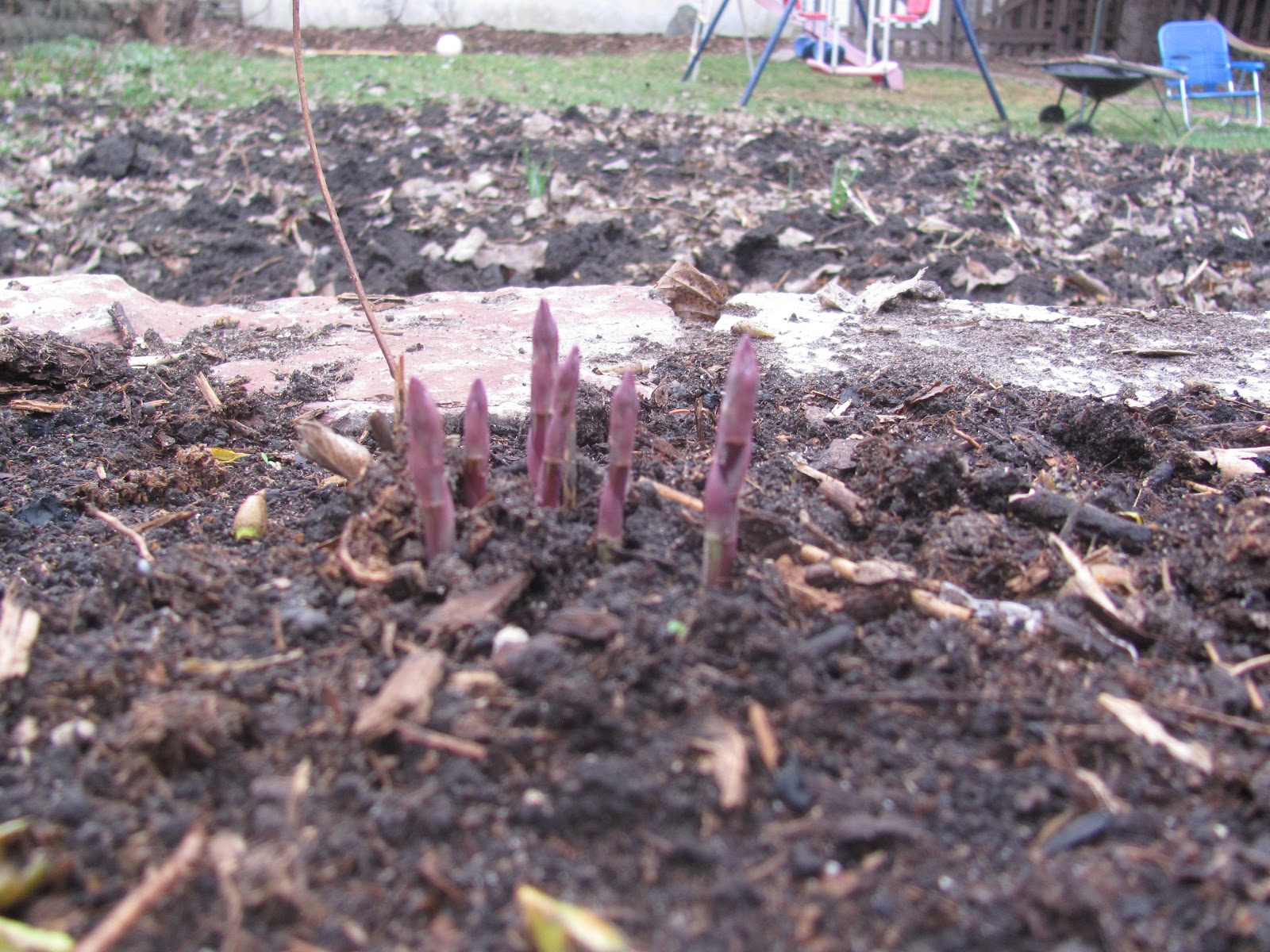
From under the bed of compost I spread just a week and a half ago, purple asparagus has already emerged- also ahead of schedule.  I'm new to asparagus, only having planted it last year, so I'm interested to see what it does.  I'm not sure if I should pick any, not wanting to set it back at all.  But really wanting to taste some of it.  Gita will have her appetite back later this week.  Maybe I should sautee some of it in butter and garlic as a surprise.  If she doesn't read this first.

One thing that I may have missed this year as a result of the early spring is the chance to experiment with grafting.  I was thinking that this might be the year I actually made it work, even joining the Upper Midwest/North American scion exchange (with many thanks to Andy at Autonomy Acres for creating it.)

I thought I might go looking for a grafting knife and some tape last weekend.  But the weekend got away from me, working on that to-do list, and grafting knives were not high at all on it.  By the time I get to it, I think the season will be long over.  Or not.  If someone wiser can advise me on the timing of grafts, I'll listen.

I'm hoping to graft a pollinator onto our plum tree, and another sweet cherry onto the Stella, and maybe some seedless grapes onto the un-named and not-very-tasty concord grape variety that's taking over our west fenceline.   But that may have to wait until next year.

I always hope that next year will be less busy, and each year it's just the opposite.  Time is more precious than money right now, and time spent with my kids is the most precious of all. 

Next year will be the year I start grafting.

Sunday, March 18, 2012

it's too nice to be indoors

these two never get tired of playing with water.  they were supposedly watering the asparagus.

Officially it's still winter.  There's still a day or two until the spring equinox, so it's still astronomical winter, at least in the northern hemisphere.

Taking a step outside told a different story though.  Warm, humid, beautiful temperatures, starting the middle of last week, and continuing through the weekend.

Monday, March 12, 2012

the difference a year makes

the backyard- March 12, 2012
The difference that a year makes?  The above photo was our backyard this afternoon.  Brown, yes, but no snow to speak of.  Tulips are starting to poke up out of the mud on the south side of the house, and the yard smells like rain, earth and the neighbor's thawing dog poop.

Now scroll down and see the exact same yard exactly one year ago.